
Why did my profit drop when my sales went up?
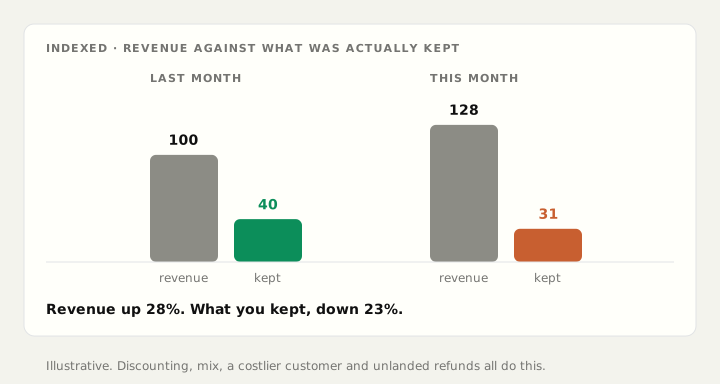
Growth changes the mix. More discounting, a heavier product, a costlier customer and refunds that have not landed yet can all move profit down while revenue moves up.
Short answer: because revenue and profit are moved by different things. A bigger month usually means more discounting, a different product mix, a more expensive customer and a wave of refunds that has not arrived yet. Each of those takes from contribution while adding to revenue.
Here are the five causes, in the order they are usually responsible.
1. You discounted your way there
The most common cause, and the easiest to miss, because the discount never appears as a cost.
A code comes out of contribution, not revenue. On a 40 percent margin, a 20 percent code takes about half of what the order was going to leave you — so a discounted month can post record revenue and less profit than a quiet one.
Check it: what share of last month's orders used a code, against the month before?
2. The mix moved to a worse product
Growth is rarely even. One product runs, and if it is a thin-margin one — heavy to ship, deeply discounted, frequently returned — your average contribution per order falls even though every individual price held.
Check it: contribution per order, this month against last. If that fell while order count rose, it is mix.
3. You paid more for the customer
Scaling ads means buying past the cheap audience. The next thousand dollars always performs worse than the average, because platforms spend the easy money first.
So cost per customer rises as volume rises, and it is charged against the same orders that made the revenue look good.
Check it: total ad spend divided by new customers, this month against last.
4. The refunds have not arrived yet
Refunds land two to three weeks after the orders that cause them. A month that grew fast is carrying refunds that will not appear until next month — so this month's profit is overstated and next month gets charged for it.
If you are comparing a growing month to a flat one, the growing month is flattered.
Check it: your settled refund rate from a month old enough to have finished refunding, not from the month you are looking at. The full version: Why did my refund rate suddenly go up?
5. Volume costs went up quietly
Shipping surcharges, a rate band you crossed, extra pick and pack, a fulfilment tier, more support hours, more chargebacks. None of these is dramatic on its own and none appears next to revenue.
Check it: what carriers billed you, divided by orders, this month against last.
The diagnosis, in order
Work through it this way and you will usually find it in the first two:
- Discount share of orders — up or flat?
- Contribution per order — did it fall?
- Cost per new customer — did it rise?
- Settled refund rate — are you comparing a young month to a mature one?
- Carrier cost per order — did it move?
The one that changed is your answer. Usually only one has moved much.
The number that would have shown you sooner
Revenue cannot tell you any of this, and neither can ROAS. Total contribution in dollars — after landed cost, real shipping, fees, discounts and refunds, minus all ad spend — moves for exactly the reasons above and for nothing else.
Track that monthly and this question stops being a surprise.
The related trap, where the ratio looks fine and the money does not: Stop Optimising ROAS. It's A Ratio, And Ratios Don't Pay Rent.
On Growth and above, Aplon shows the contribution on each order (after discounts, refunds, product cost and payment fees) and the gross profit on each product, so a month that grew and kept less shows you where to start looking. See what changed.
Free, no account
See what your own storefront shows a shopper and Google.
Store Scan reads your public pages and tells you what is missing. Titles, descriptions, headings, image alt text and page weight. Nothing to install.
Scan my storeAplon turns your Shopify store into profit analytics. See how it works.