
Why did my refund rate suddenly go up?
Usually nothing changed. Refunds arrive weeks after the orders that caused them, so growth hides your real rate and a flat month reveals it.
Short answer: usually nothing about your product changed. Refunds arrive two to three weeks after the orders that caused them. While you are growing, that lag hides your real rate. The moment growth flattens, the rate appears to jump — but it was always that high.
Here is the arithmetic, then the things that would be a real problem.
The maths that fools almost everybody
Last month you did 100 orders. This month you did 200.
The refunds landing this month mostly belong to last month's 100 orders. Say eight come back.
You do the obvious sum: 8 refunds ÷ 200 orders this month = 4%. Looks great.
The honest sum is 8 refunds ÷ the 100 orders that actually produced them = 8%. Exactly double.
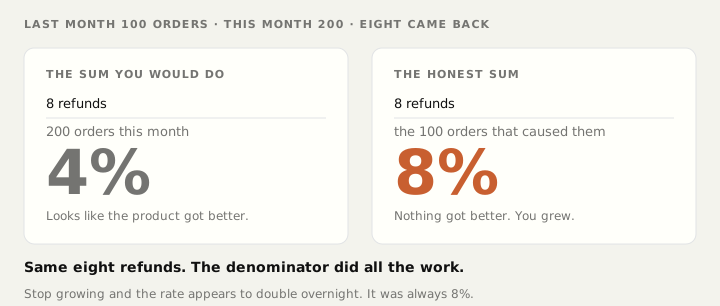
Nothing improved. You grew, and growth stuffed the bottom of the fraction with orders too young to have failed yet.
Now run it forward. Next month you do 200 again. The refunds from this month's 200 finally arrive — sixteen of them. Sixteen against 200 is 8%.
Your refund rate has apparently doubled overnight. Your supplier did not slip. Your packaging is the same. You just stopped growing fast enough to hide it.
This is the single most common false alarm in ecommerce reporting, and it sends people off to fix a quality problem that was never there.
How to tell whether it is real
Stop measuring refunds by the month they were processed. Measure them by the month the order was placed.
Ask: of the orders placed in March, what share eventually came back? Then the same for April, May, June. Only use months old enough to have finished refunding — three or four months back for most stores.
That series has a stable, meaningful answer. If it is flat, nothing is wrong and you were looking at a calendar artefact. If it is genuinely climbing cohort over cohort, something changed and it is worth chasing.
What a real increase usually is
If the cohort series really is rising, look here first, roughly in order of likelihood:
- A new supplier or a new production batch. Check whether the rise concentrates in specific products or variants rather than spreading evenly.
- A sizing change. In clothing this is the biggest single cause, and it often follows a supplier switch nobody flagged as a product change.
- A new sales channel or country. International orders and marketplace traffic frequently return at a different rate. Check whether the rise is concentrated by destination.
- A change in your ads. Traffic from a new audience, a discount-led campaign or an aggressive creative can buy customers with a much weaker intent to keep the item. This one is easy to miss because it looks like a product problem and it is an acquisition problem.
- Shipping times getting longer. Late parcels get refused and refunded, and carrier performance drifts quietly.
- A change to your own returns policy — a longer window, or free return shipping — which raises the rate on purpose. Worth remembering before treating it as a fault.
What to do about the number itself
Hold a reserve. If your settled rate is 8%, then 8% of this month's revenue is not yours. Subtract it before you look at the figure, every month, automatically. You will be roughly right instead of precisely wrong, and it stops the monthly whiplash.
Judge campaigns late enough. Work out your typical order-to-refund gap. If it is around fifteen days, a campaign is not really readable until roughly three weeks in. Watch it before then; do not double the budget on it.
Date refunds against the order, not the day the money left. Keep the cash-dated view for your accountant, where it belongs, and use the order-dated one for every decision about what worked.
The longer version, with the advertising consequences: Your Refunds Arrive Two Weeks Late.
Aplon dates every refund against the order that caused it, so a growth spurt cannot hide your real rate. See your settled numbers.
Free, no account
See what your own storefront shows a shopper and Google.
Store Scan reads your public pages and tells you what is missing. Titles, descriptions, headings, image alt text and page weight. Nothing to install.
Scan my storeAplon turns your Shopify store into profit analytics. See how it works.