
Your Refunds Arrive Two Weeks Late. That's Why Your Best Month Is Fiction.
Refunds land long after the orders that caused them. That single lag makes recent months look better than they are, and makes growth look like quality.
A refund does not happen when the order happens.
The customer buys. The parcel takes a few days. They open it, live with it a while, decide against it, start a return, post it back, and eventually somebody approves it. For most stores that gap runs somewhere around two to three weeks. Yours is worth measuring rather than guessing, because everything below depends on it.
That lag is not interesting on its own. What it does to every report you read is very interesting indeed, and almost nobody adjusts for it.
The last 30 days is always flattering
Look at your last 30 days. Revenue, refunds, what you kept.
The orders in that window are young. Most of them have not yet had the chance to come back. The refunds sitting in the window belong mostly to the month before, when you had fewer orders.
So your most recent period is being charged for an older, smaller period's mistakes, while its own mistakes have not shown up yet.
Your last 30 days will look better than it turns out to be. Every single time. Not because anybody is fiddling anything — because of the calendar.
Growth hides your refund rate, then hands you the bill
This is the part worth sitting with.
Say last month you did 100 orders. This month you did 200. Congratulations.
The refunds that land this month mostly belong to last month's 100 orders. Say eight of them come back.
You do the obvious sum: 8 refunds against 200 orders. 4%. Lovely.
The honest sum is 8 refunds against the 100 orders that actually produced them. 8%. Exactly double.
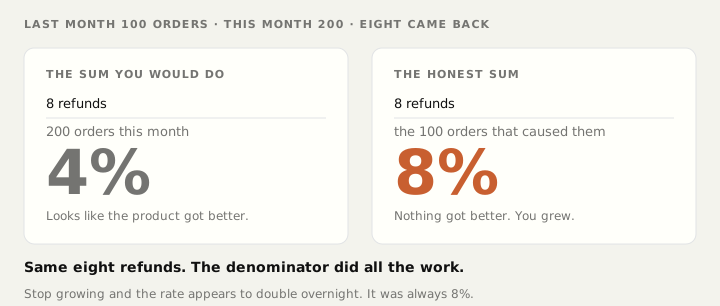
You did not improve anything. You grew, and the growth stuffed the bottom of the fraction with orders too young to have failed yet.
Now run it forward. Growth flattens out. Next month you do 200 again, and the refunds from this month's 200 finally arrive — sixteen of them. Sixteen against 200 is 8%.
Your refund rate has apparently doubled overnight. Nothing changed. Your supplier did not slip, your product did not get worse, your packaging is the same. You just stopped growing fast enough to hide it, and the number caught up with reality.
This is one of the most common false alarms in ecommerce, and it sends people off to fix a quality problem that was never there. The reverse is worse: a store scaling hard reads its flattering refund rate as proof the product is loved, and pours money in.
Two ways to date a refund, and you need both
When a refund arrives, you can file it two ways.
On the day the money left. This is what your bank sees and what your accountant wants. It answers: how much cash moved in March?
Against the order that caused it. This answers a completely different question: was that campaign, that cohort, that product actually any good?
Most tools do the first and call it done. But almost every decision you make is really about the second.
If you spent $2,000 on ads in the first week of March and want to know whether it worked, the refunds against those specific orders are part of the answer, even though the money did not leave until April. File them under April and March's campaign looks better than it was, forever. You will never go back and correct it, and you will scale off the wrong number.
What this does to your advertising
Here is the sequence that costs real money.
Day 1 to 7: you run a campaign. You judge it at the end of the week. Return looks like 2.4. Good.
Day 8: you double the budget on the strength of that.
Day 15 to 25: the refunds from week one arrive. The real return on that campaign was 1.9, not 2.4.
By the time you can see that, you have spent two weeks at double budget on the strength of a number that was never true. And when you eventually look at the whole month, the poor result is smeared across both weeks, so you cannot tell which decision was the bad one.
If you sell anything with a meaningful return rate — clothing above all, but also anything sized, anything fragile, anything bought as a gift — your seven-day ad numbers are structurally optimistic, and you have been scaling on them.
What to do instead
Judge cohorts that have grown up. Work out your typical order-to-refund gap. Then only make big calls on periods older than that. If your gap is fifteen days, a campaign is not really readable until about three weeks in. Watch it before then, by all means. Do not double budget on it.
Hold a reserve. If your settled refund rate is 8%, then 8% of this month's revenue is not yours. Subtract it before you look at the number, every month, automatically. You will be roughly right instead of precisely wrong, and you will stop the monthly whiplash.
Report refunds against the order, not the day. When you ask whether something worked, the refund belongs to the thing that caused it. Keep the cash-dated view for your accountant, where it belongs.
Watch the rate by cohort, not by month. "Of the orders placed in March, what share eventually came back?" That question has a stable answer that means something. "How many refunds happened in March?" is a fact about your returns desk, not about your product.
The one-minute version
Take last month's revenue. Take your true settled refund rate — from a month old enough to have finished refunding, not from last month. Multiply. Subtract.
That is closer to what you made.
It is a smaller number. It is also the one you can plan with, and it will not ambush you in eight weeks.
Aplon dates every refund against the order that caused it, so campaigns, products and cohorts are judged on what actually stuck. See your settled numbers.
Free, no account
See what your own storefront shows a shopper and Google.
Store Scan reads your public pages and tells you what is missing. Titles, descriptions, headings, image alt text and page weight. Nothing to install.
Scan my storeAplon turns your Shopify store into profit analytics. See how it works.