
What is a good ROAS for a Shopify store?
There is no universal number. Your break-even ROAS is 1 divided by your contribution margin, and anything below it loses money. Work yours out in two minutes.
Short answer: there is no universal good ROAS. Your break-even is 1 divided by your contribution margin. A 40% margin needs 2.5x just to break even. A 70% margin breaks even at 1.43x. Anyone who gives you a target number without asking about your margins is guessing.
Here is how to work out yours, and why the usual benchmarks are worse than useless.
Work out your number in two minutes
Take a typical order. Work out what survives after:
- What the product cost you, landed — supplier invoice plus freight, duty and clearance
- What the carrier actually charged you to ship it
- Picking, packing and materials
- Payment processing, at your real blended rate from the statement
If a $100 order leaves you $40 before advertising, your contribution margin is 40%.
Now divide 1 by that:
- 30% margin → break-even 3.33x
- 40% margin → break-even 2.50x
- 50% margin → break-even 2.00x
- 70% margin → break-even 1.43x
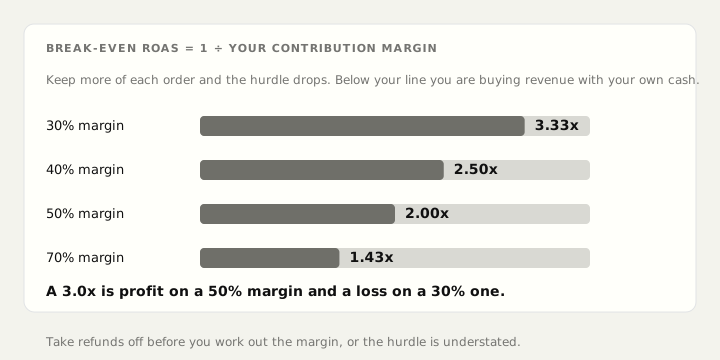
Above your number you make money on ads. Below it you are buying revenue with your own cash.
Two adjustments people forget. Take refunds off first, or your margin is overstated by whatever comes back. And if your reporting counts organic customers as paid — most do — your true ROAS is lower than the screen says, so leave yourself room.
Why the same ROAS is great and terrible
Sell a $100 item that costs you $20. After everything you keep about $70. At 3.0x ROAS you spent $33 to make $100, kept $70, and are $37 up. Excellent.
Sell a $100 item that costs you $65. After everything you keep maybe $25. Same 3.0x, same $33 spent — and you lose $8 on every order. Scale it and you lose faster.
Identical number. Opposite businesses. This is why "what's a good ROAS?" has no answer in the abstract.
The mistake that costs more than the wrong benchmark
Your account shows 3.2x overall, comfortably above your 2.5x break-even. So you should spend more?
Maybe not. That 3.2x is an average across everything — including retargeting people who already had your product in a basket, which might be running at 9x, and cold prospecting running at 1.4x.
The only question that matters when setting a budget is: what does the next thousand dollars do? Not what the last ten thousand did on average.
The next thousand always performs worse than the average, because platforms spend the cheap, easy money first. That is what they are built to do. So your real spending ceiling is where the next dollar drops below break-even — and that is always at a lower spend than the average suggests.
To find it: raise budget in steps, wait for results to settle, and watch what the increase returned rather than what the total says.
The easiest way to fake a great ROAS
Turn off everything aimed at people who have never heard of you. Keep only ads shown to your email list and to people who abandoned a basket yesterday. Cut the budget to almost nothing.
Your ROAS will look superb. Your revenue will collapse.
ROAS is a ratio, and you can always improve a ratio by shrinking the bottom of it. That is worth remembering both when you judge your own account and when somebody shows you theirs.
What to optimise instead
Total contribution profit, in dollars.
Take everything the orders contributed after product cost, delivery, fees and refunds. Subtract all ad spend. That number goes in the bank, and it is the one to compare month to month.
A month at 4.0x on small spend can easily beat a month at 2.6x on large spend — or lose to it. Only the dollars at the end tell you which.
The longer version, with worked examples: Stop Optimising ROAS. It's A Ratio, And Ratios Don't Pay Rent.
Aplon works out your contribution per order from your real costs and shows what each channel returned after them. Find your break-even.
Free, no account
See what your own storefront shows a shopper and Google.
Store Scan reads your public pages and tells you what is missing. Titles, descriptions, headings, image alt text and page weight. Nothing to install.
Scan my storeAplon turns your Shopify store into profit analytics. See how it works.