
Am I losing money on shipping?
Almost certainly, and it rarely shows up as a line anywhere. What customers pay you and what carriers bill you are two separate numbers, and unless you buy your labels through Shopify, nothing puts them side by side.
Short answer: most stores are, and they cannot see it. What customers pay you for delivery arrives as revenue. What the carrier bills you leaves as a bank payment weeks later. Unless you buy your labels through Shopify, nothing in Shopify puts the two in the same sentence, and even its labels report leaves out adjustments and return labels. So delivery quietly reads as a source of income while costing you money on every order.
Here is how to find your number in about two minutes.
The two-minute check
Take last month. Two figures:
- What you collected from customers in delivery charges. In Shopify's reports this is the shipping line, separate from product revenue.
- What your carriers actually billed you. From the carrier invoice, not from your rate card.
Subtract the second from the first.
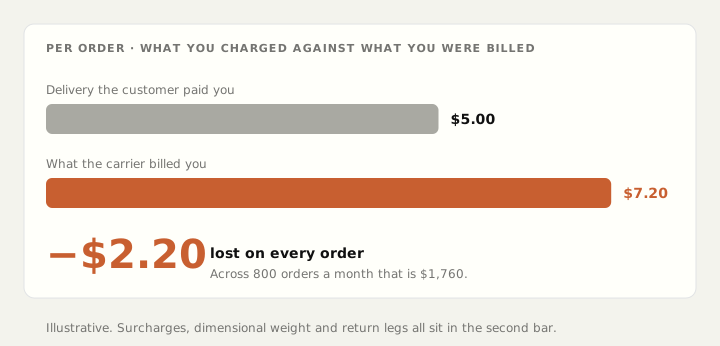
What good looks like: roughly break-even, or a deliberate loss you have chosen and sized as a marketing cost.
What most stores find: a loss they did not know about, because the two halves never met.
Why the gap is almost always the wrong way round
Five things push your real cost above what you charged.
Surcharges are not in your rate card. Fuel, residential delivery, remote area, oversize, address correction. These are added after the fact and can be a meaningful share of the bill.
Dimensional weight. Carriers charge on size as well as weight. A light, bulky item bills as if it were heavy, and nothing at checkout knows that.
Free shipping thresholds get stale. Yours was probably set once, in year one, to a round number somebody liked. Your product mix, your carrier rates and your average parcel have all moved since. The threshold has not.
Returns ship twice. A refunded order that you paid to send out and paid to bring back costs you delivery in both directions, plus the refunded shipping revenue.
International is a different business. Duty, customs handling and remote surcharges make cross-border parcels cost multiples of a domestic one, while the checkout often quotes a flat rate.
The threshold question
If the gap is bad, look at your free-shipping threshold before anything else. It is the single biggest lever and the one most likely to be wrong.
The honest way to set it: work out your contribution per order, and set the threshold where the extra order value more than covers the delivery you are absorbing. If your average parcel costs you seven dollars and your contribution margin is 40%, you need roughly eighteen dollars of additional order value to break even on giving that delivery away — before it earns you anything.
Most thresholds are set below that, which means free shipping is not a promotion, it is a subsidy.
What to do this week
- Do the two-minute check. Collected versus billed, last month.
- Divide by orders to get the gap per order. That is the number to carry around.
- Add it to your contribution maths. If you were using the delivery customers paid as revenue and never subtracting the carrier bill, every margin figure you have is overstated.
- Re-set the threshold if the gap is real, using contribution rather than a round number.
- Check international separately. It often hides a loss that the domestic average washes out.
The full subtraction, with delivery in its proper place: How do I work out my real profit per order on Shopify?
On Growth and above, Aplon's Profit & Loss puts what you charged customers for delivery next to what your carriers billed you, once you log those bills as shipping expenses, so delivery appears as the cost it is. See your shipping gap.
Free, no account
See what your own storefront shows a shopper and Google.
Store Scan reads your public pages and tells you what is missing. Titles, descriptions, headings, image alt text and page weight. Nothing to install.
Scan my storeAplon turns your Shopify store into profit analytics. See how it works.