
How do I work out my real profit per order on Shopify?
Shopify shows what customers paid, not what you kept. Here is the full subtraction on one order, with the three costs stores most often miss.
Short answer: take what the customer actually paid, then subtract landed product cost, what the carrier charged you, payment processing at your real rate, packing, your advertising cost per order, and your settled refund rate. What is left is your contribution per order — and it is usually between a third and a half of what people assume.
Here it is on one order.
The order
A customer buys a $100 product, pays $5 delivery, and uses a 10% code.
Collected: $95. That is $100 minus the $10 discount, plus the $5 of delivery they paid.
The subtraction
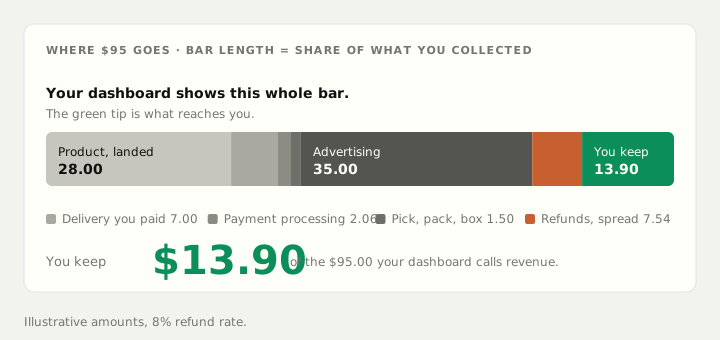
- Product, landed: $28. Not the supplier invoice — the invoice plus freight in, plus duty, plus clearance, divided by units received. Most stores enter the invoice price alone and understate this by 10 to 25%.
- Delivery you actually paid: $7. The carrier's bill, including fuel and residential surcharges.
- Payment processing: about $2. Your real blended rate from the statement, not the advertised one.
- Pick, pack and box: $1.50. Somebody's time and some cardboard. If you do it yourself it still costs; it is just paid in evenings.
That leaves $56.50. This is your contribution margin — what one more order contributes before any fixed costs. It is the most useful number in ecommerce and almost nobody can tell you theirs.
- Advertising: $35, if that is your cost to acquire a customer. Now you are at $21.50. Note that advertising just ate 62% of everything the order contributed, and Shopify never mentioned it, because Shopify does not know what you spend on Meta.
- Refunds: about $7.50. If 8% of orders come back, then across a hundred orders like this one, eight reverse — you refund the $95, you have already paid the processing fee, and you may not resell the item. Spread across the hundred, that is what each one really carries.
You keep roughly $14.
Fourteen, not ninety-five
That is not a disaster. A 15% contribution after advertising is a working business. The disaster is not knowing, because everything you decide next depends on which number is in your head.
At $95, a 20% off sale sounds like a promotion.
At $14, a 20% off sale is you paying customers to take your stock. Nineteen of your $95 is more than everything you were keeping.
That is how a store runs a "successful" campaign, hits record revenue, and ends the month with less money than it started with. Every number they looked at went up.
The three costs stores miss most often
Delivery is two numbers, not one. What customers paid you and what carriers charged you. Most reporting counts the first as revenue and never goes looking for the second, so delivery quietly becomes a source of income while costing you money on every order.
Landed cost, not invoice cost. Freight, duty and clearance are real and they belong in the product cost.
The refund you have not had yet. Recent orders have not had time to come back. Any margin figure based on last month is structurally optimistic.
Do it on your own numbers
Take one full month and write six lines:
- Total collected, from Shopify.
- Minus refunds for that month.
- Minus the landed cost of everything that sold.
- Minus what carriers actually charged you.
- Minus payment processing, from the statement.
- Minus every dollar of advertising, from the platforms rather than from memory.
Divide what is left by your order count. That is what one order is worth to you — and it is the number that should decide your ad budget, your free-shipping threshold, your discount policy, and whether a new product is worth stocking.
A few people find it is negative on their best-selling product. That is a rough afternoon and the most valuable thing they learn all year.
The full walkthrough, including what Shopify does and doesn't handle: Your Shopify Dashboard Is Lying To You About Profit.
Aplon does this subtraction on every order automatically — landed costs, real carrier charges, processing fees, ad spend and refunds. See your real margin.
Free, no account
See what your own storefront shows a shopper and Google.
Store Scan reads your public pages and tells you what is missing. Titles, descriptions, headings, image alt text and page weight. Nothing to install.
Scan my storeAplon turns your Shopify store into profit analytics. See how it works.