
Why is so much of my Shopify traffic showing as direct?
Almost nobody types your URL. Direct is where analytics files a visit it could not identify — and a growing share of it now arrives from AI assistants.
Short answer: almost none of it is people typing your address. Direct is the bin your analytics uses when it cannot work out where a visit came from. Every one of those visitors came from somewhere — you are just not being told where.
Here is what is actually in there, and how to shrink it.
Why a visit loses its name
When somebody clicks a link, their browser normally tells the destination which page they came from. That is the referrer, and channel reporting depends on it.
These strip it:
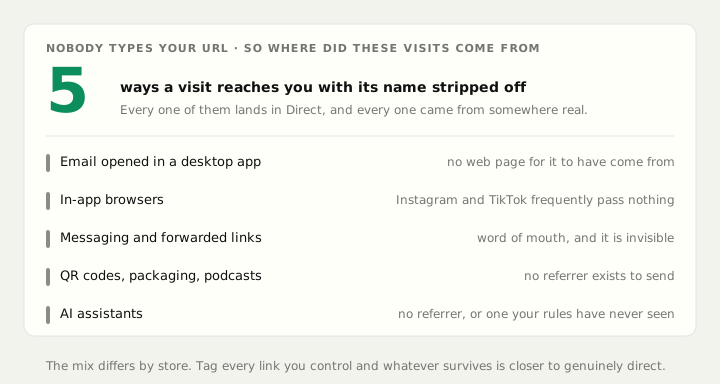
Email opened in a desktop app. There is no web page for the click to have come from. Unless your email tool tagged the link, that customer arrives anonymous. This is why email is chronically undervalued — a chunk of its results sit in Direct, credited to nothing.
In-app browsers. Instagram, TikTok and Facebook open links inside their own browser, which frequently passes nothing useful. Your customer came from Instagram; your report says Direct.
Messaging and forwarded links. WhatsApp, iMessage, a link pasted into a group chat. Word of mouth is the most valuable traffic you will ever get and it is almost entirely invisible.
QR codes, packaging, podcasts, anything offline. No referrer exists to send. If you did not print a tagged URL, it lands in Direct.
AI assistants. People now ask an assistant what to buy and get linked straight to a product page. Some send no referrer; some send one your analytics has never heard of and has no rule for. Unlike everything else on this list, this one is growing every month.
Two silent bugs worth ruling out
Both are common and neither ever reports itself.
Substring matching on your own domain. The lazy way to check whether a visit came from your own site is to ask whether the referrer contains your domain. yourstore.com is inside yourstore.com — and also inside notyourstore.com and anything else somebody registers. Affiliates and competitors on lookalike domains get counted as internal traffic and vanish from your reports. The fix is matching on the domain boundary, not on whether the text appears somewhere.
Only knowing one of your addresses. Your store has a myshopify address and a real one. If your analytics knows only one, traffic bouncing through the other reads as external when it is internal, or the reverse. Both need to be on the list.
How to shrink Direct this month
You will never get it to zero, and you should not try — some people really do bookmark. But most of it is recoverable, and the work is dull rather than hard.
- Tag every link you control. Email, your own social posts, your newsletter, the link in your bio, packaging inserts. This takes the biggest bite by far.
- Give every offline thing its own URL. A QR code on an insert should point at a tagged address. Now your printed material has a measurable result, probably for the first time.
- Check your own-domain matching. Confirm both addresses are recognised and that the check is on the whole domain.
- Add rules for AI assistants, or use a tool that has them. This is the fastest-growing slice of your unknown traffic.
- Look at what survives. That remainder is closer to genuinely direct — repeat customers and people who actually remember you. That number means something. The one you have today does not.
Why it is worth the afternoon
Because you are setting budgets with this.
Every visit that lands in Direct is credit taken away from whatever earned it. Your email looks weaker than it is. Word of mouth looks like it barely exists. Your organic social looks like it does nothing, so you stop posting.
Paid ads, meanwhile, look comparatively strong — because paid traffic arrives with a tag attached and almost never loses its name.
That is the quiet bias in nearly every ecommerce report: the channels you pay for are the best at identifying themselves. The free ones lose the argument month after month, and the budget follows.
The longer version: Direct Is Not A Traffic Source. It's Where Your Analytics Gave Up.
Aplon matches referrers on the full domain, recognises AI-assistant referrals as their own channel, and shows you what is really left in Direct. See your channel mix.
Free, no account
See what your own storefront shows a shopper and Google.
Store Scan reads your public pages and tells you what is missing. Titles, descriptions, headings, image alt text and page weight. Nothing to install.
Scan my storeAplon turns your Shopify store into profit analytics. See how it works.