
The 20-Minute Shopify Profit Audit
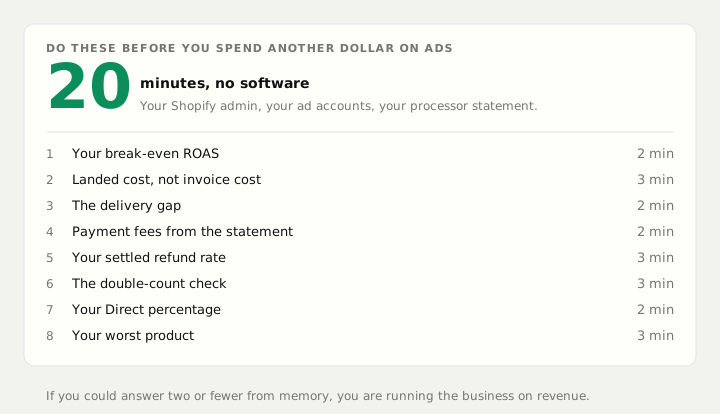
Eight checks, twenty minutes, no software. Do these before you spend another dollar on ads and you will know more about your store than most owners know about theirs.
You do not need a tool for this. You need twenty minutes, your Shopify admin, your ad accounts and your payment processor's statement.
Eight checks. Each one takes two or three minutes. At the end you will have eight numbers, and any one of them can change what you do next week.
Do them in order. They build.
1. Your break-even ROAS — 2 minutes
Take a typical order. Work out what survives after product cost, delivery you paid, packing and payment fees, but before advertising. If a $100 order leaves you $40, your contribution margin is 40%.
Divide 1 by that. 40% gives you 2.5.
That is the ad return you must beat to make a single dollar. Below it you are buying revenue with your savings.
What to do: write it on a sticky note and put it on your monitor. Every ad decision for the rest of the year gets compared to this one number.
2. Landed cost, not invoice cost — 3 minutes
Pick your three best-selling products. For each, find what you actually paid to have one sitting in your warehouse ready to ship.
That is the supplier invoice plus freight in, plus duty, plus customs clearance, plus any inspection, divided by units received.
Compare it to the cost you have entered in Shopify.
What you will probably find: the entered cost is the invoice price and nothing else. Most stores understate product cost by somewhere between 10 and 25% this way.
What to do: fix the three you just checked, today. Then work through the rest in order of sales volume.
3. The delivery gap — 2 minutes
Two numbers from last month. What you collected from customers in delivery charges. What your carriers actually billed you.
Subtract.
What good looks like: roughly break-even, or a deliberate, known loss you have chosen as a marketing cost.
What you will probably find: you are losing money on delivery and it has never appeared as a line anywhere, because the money customers paid you shows up as revenue and the carrier's bill shows up as a bank payment, and nothing ever puts them in the same sentence.
What to do: if the gap is bad, look at your free-shipping threshold first. It is usually set to a round number somebody picked in year one, not to a number that covers the average parcel.
4. Payment fees from the statement — 2 minutes
Open your actual processor statement for last month. Find the total fees. Divide by the revenue that went through it.
Use the statement, not the advertised rate. The advertised rate is for a domestic card in the simplest case. Your real blended rate includes international cards, wallets, currency conversion, chargebacks and every extra your particular mix attracts.
What to do: put the real percentage into your margin calculation from check one, and redo it. It usually moves the break-even ROAS more than people expect.
5. Your settled refund rate — 3 minutes
Not last month. Last month is a lie, because its orders are too young to have been refunded yet.
Go back far enough that the period has finished refunding — three or four months ago for most stores. For those orders: what share eventually came back?
Why this matters more than it sounds: a growing store always looks like it has a low refund rate, because this month's big order count sits underneath refunds generated by a smaller past month. Grow fast enough and you can halve your apparent rate without changing anything at all. Then growth flattens, the real rate arrives, and it looks like a sudden quality problem.
What to do: take that settled percentage off the top of every revenue figure you look at from now on. That share of the money is not yours.
6. The double-count check — 3 minutes
Add up the sales each platform claims for last month. Meta, Google, TikTok, your email tool, everything.
Compare it to your actual Shopify order count for the month.
What you will find: the claimed total is bigger. Usually much bigger.
That difference is customers being counted more than once — one buyer touched by three channels, with all three reporting the sale. Nobody is lying. Each platform is honestly answering "did I touch this?" It only becomes fiction when you add them up.
What to do: stop adding platform conversions together, in every report and every conversation. Then calculate your blended return instead: total revenue divided by total ad spend. It cannot be gamed by a settings change.
7. Your Direct percentage — 2 minutes
Open your analytics and find Direct.
Direct is supposed to mean somebody typed your address from memory. Ask yourself how many of your customers plausibly did that.
Everything in that bucket came from somewhere. Email opened in a desktop app. A link in a WhatsApp group. An in-app browser on Instagram. A QR code on your packaging. Increasingly, an AI assistant recommending you — a source most analytics tools still have no rule for.
What to do: put tracking tags on every link you control — email, your own social posts, the link in your bio, anything printed. It is dull and it is the single fastest way to shrink that bucket. Whatever survives is closer to genuinely direct, and then it actually tells you something.
8. Your worst product — 3 minutes
Export your products sorted by revenue. Now, for the top ten, work out contribution per order using the real costs from checks two, three and four.
Re-sort by that.
What you will find: the order changes. Sometimes dramatically. Your number-three revenue product is occasionally your number-nine profit product, and your quiet number-seven is carrying the store.
What to do: whatever you feature, discount, bundle and advertise should be decided from the second list, not the first. Most stores are promoting the first list because it is the one Shopify shows them.
Score yourself
Before today, how many of these eight could you have answered from memory?
- Six or more: you are in a small minority and you already know it. Skip to marginal ROAS — what the next thousand dollars returns, not the average.
- Three to five: you know your business but you are probably losing money in one specific place, and it is usually delivery or landed cost. Go and check those two properly.
- Two or fewer: you are running the business on revenue. That is not a criticism, it is where nearly everybody starts, and the good news is that the first three checks alone will move real money.
The one that matters most
If you only do one, do check one.
Not because it is the most interesting, but because every other decision points back at it. Your ad budget, your discount policy, your free-shipping threshold, whether a new product is worth stocking, whether that influencer deal makes sense.
All of them are the same question in different clothes: what is one more order actually worth to me?
Most owners have never worked it out. The ones who have make faster decisions and worse-sounding ones — smaller sales, higher shipping thresholds, less discounting — and keep more money.
Aplon runs all eight of these continuously from your Shopify data, your real costs and your ad accounts. See what it finds in your store.
Free, no account
See what your own storefront shows a shopper and Google.
Store Scan reads your public pages and tells you what is missing. Titles, descriptions, headings, image alt text and page weight. Nothing to install.
Scan my storeAplon turns your Shopify store into profit analytics. See how it works.